Did they clear out the spruce / pine trees forests?
The wind resource is significantly worse in wooded areas. The ideal setting is dead flat - hence the appeal of ocean deployment. Any sort of object that causes a change of wind direction sacrifices a lot of power, as does an irregular surface such as a forest.
3 Likes
I think it varied, but that was the idea. There was a forest in Fife that I often walked the dogs in, and they would clear an area for timber, install a turbine, and replant around it.
If you want to see environmental destruction in Scotland, just check out the grouse moors.
3 Likes
For reasons that don’t extend much beyond “it’s cheap”, this is the fastest growing region of the US
https://x.com/jonathanweisman/status/2089480047266554058?s=20
1 Like
2 Likes
The tldr is that this design is really only good at utilizing mediocre wind resources, and is unable to capture the vast majority of energy from a good wind resource.
3 Likes
I liked the thought that there are still clever people pecking away at making things better for the environment… As in, from one good idea, another will spring from it… 
4 Likes
Would that also be true if this kind of turbine was much bigger?
It’s interesting that it produces much less noise than a conventional turbine, and is less dangerous for birds.
1 Like
The video makes it sound like it is a radical innovation, but the idea of using an Archimedean screw to harness wind has been around for a while. It is essentially a more efficient permutation of the Savonius design. It has all of the benefits claimed in the video, low cut-in speed, etc.
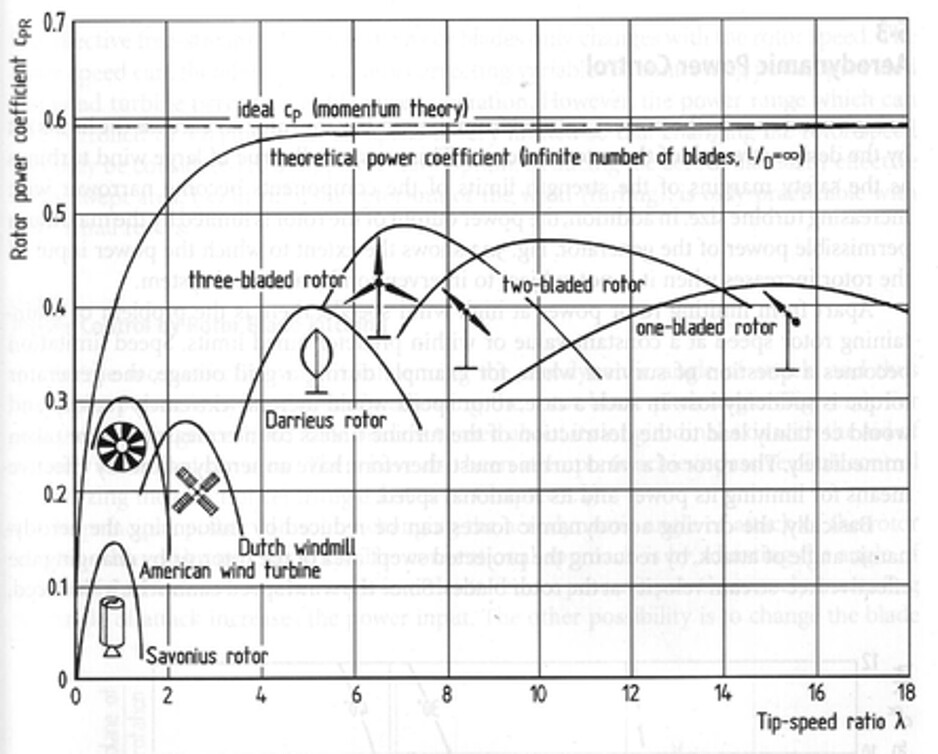
As you can see from that graph, the Savonius is great at harvesting the wind resource at very low tip speeds (which are a function of wind speed), and as stated in the video it is not particularly susceptible to changes in wind direction. However, it falls far below the theoretical extraction limit (the Betz limit) of 16/27 of the wind energy and saturates at speeds below the cut-in speed of most other designs.
The property of being able to generate almost all the time sounds great, but once you understand where the energy actually is it becomes evident why the three-blade monopole design is dominant. Power density is given by the function:
P = ½ * ρ * A * v3
Where ro is the air density (not a constant, but not far off), A is area (circle of the blade sweep for the conventional design) and the cube of velocity.
So, where the Savonius type can capture energy at 3 m/s before the other design even cuts in, it will peak around 5 m/s. Assuming a 1 meter area and air density of 1 kg/m3 (1.225 kg/m3 at 15 C at sea level, but math kept easy for illustrative purposes) at 5 m/s there will be 62.5W available. The Savonius will capture a peak of 15%, and down to about 8% at 5 m/s, so not quite 5.5W of output.
By contrast, the 3-blade is cutting in usually around 4 m/s and capturing perhaps 40%, so 24W at 5 m/s. But the real story is when the wind reaches 11 m/s or thereabouts. With 665W of energy available, the 3-blade will be approaching 48%, or about 320W. The Savonius will still be spinning out 5.5W. At 320W, it doesn’t take long to overhaul the 5.5W, even if the 5.5 is near constant.
11 Likes
Thanks for posting this. I had always wondered about that.
2 Likes
2 Likes