Surely the biggest contributing factor for Labour winning was people voting to get the Tories out.
The main reason for Labour and other votes was abc.
Sure, but these were seats labour had held going into the election , and were expected to retain given the opportunity for the party to win the election, so while it was picking up seats to get the Tories out, it’s own grass root support was willing to take a stance against their own party, costing them seats. That has been festering and contributed significantly to the lack of popularity of Starmer and his government.
1 Like
1 Like
I’m contemptuous of most politicians for precisely that reason. If Burnham pulls the same stunt then he can fuck off too.
Did the majority of electorate vote to reduce Britains wealth and standard of living in favour of Brexit? Or did they just vote for Brexit?
I appreciate you are more informed in this area than myself, but would it be wrong to take into consideration the ‘cut off one’s nose to spite their face’ approach of people reluctant to accept the vote?
The Bond marketing in the current climate is not really favouring anyone. The US, Japan, the UK, etc. Also, there is a real over investment in AI that is now causing a concern.
Out of interest, how are the Bunds fairing in Germany? And how is France’s borrowing going?
The UK has created its own problems, long before Brexit.
Brexit was always going to reduce British wealth and standard of living for at least the short term. That was obvious and indisputable, despite the fact that Carney was attacked for doing so and taking steps in monetary policy to minimize that.
There were perhaps possible universes where Britain would see longer term benefit, based on negotiation of trade deals with the EU and other partners, but that is not what happened.
However, the first part, being the short term costs, was absolutely clear. The British electorate voted for that. The fact that the indefinite future benefits remain exactly that are neither here nor there. Brexit was always short term cost for uncertain future benefit.
The acceptance of the vote in economic terms is irrelevant. Brexit happened, whinging or otherwise. Whinging doesn’t change the terms of trade.
Writ large, most of British politics in the past decade have been about avoiding the consequences of that social choice, largely by demographical groups responsible for making it.
3 Likes
As for rhe global bond market, yields everywhere are being pushed higher. Basically, the bill on covid is coming due. Some countries are seeing modest pressure,but some that are avoiding a reckoning are seeing something more dramatic. The UK is in that group, the US obviously, but France as well
2 Likes
Your % did surprise me, so much so that I had to google it and it appears you are correct. Although, I think this is a direct unemployment benefit and does not take into consideration benefits of the back of it. Whether it is much more I don’t know.
For me, the unemployment issue is a double whammy. In that we have 1m people falling in the NEET category, where there is a cost but also a negative impact in that they are not paying taxes/NI because they don’t earn.
So we have 1m NEET’s yet how many of these do you see on a deliveroo bike, delivering Amazon parcels?
Is this because they can get by on their minimal wages topped up by benefits or are they just too lazy?
1 Like
I still disagree with the vote being purely on an economic basis. If you believed Osbourne, the UK would require an emergency budget, there would be a recession, etc. The leave party didn’t have a mandate and any terms had to be negotiated with the EU and voted through Parliament.
However, I whole heartedly agree with your point about it has happened and there is no point in whinging about it. Maybe, if we took that into our negotiations we may have got a better deal - but that is an unknown.
I personally believe that the UK voting Brexit, Covid, Ukraine War, Trump and the recent/ongoing US/Iran war have provided our two main parties whilst in government a cheap excuse for not delivering.
Do you have any insight/views on Germany/France? Just for comparison
There was evidence that many people voted simply to “stick one to the man”. I.e. a protest vote against austerity that they had little idea what the consequences were.
5 Likes
I don’t know whether it would provide an answer to this, but Alexei Sayle has recently published a book about his history of street demonstrations:
I have heard him talking about the Gaza protests. He has mentioned that he, and other Jewish protesters, have made a point of being visible at the front of these. Partly, this is to show solidarity, but also to make the point that the protests are not antisemitic in nature. (Although whether they still attract antisemitic elements is another matter).
5 Likes
Didn’t they also vote for that austerity?
1 Like
Not necessarily. I found this as an estimate of vote by party affiliation:
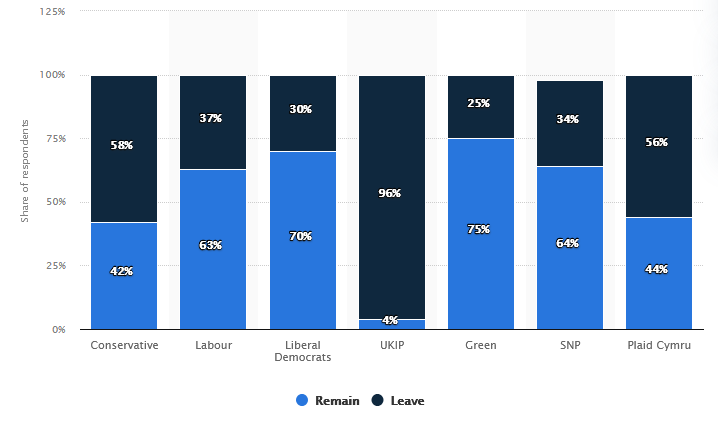
In addition, it was estimated that up to 3 million Leave voters hadn’t voted in the previous general election.
3 Likes
Interesting unfortunately it doesn’t give an idea of number of votes. If it’s correct UKIP was massive.
1 Like
There is only one out-door, market correction.
I have seen a much more detailed analysis before but I couldn’t find it. I seem to recall that YouGov gave more specific breakdowns, but that does rely on people being truthful.
2 Likes
Healy pledges growth….. how many times have we heard that from the last 10 Chancellors.
Healey says he’s also looking at national policy to create the right conditions for the private sector to flourish.
He says the UK has had one of lowest rates of investment in the G7 “for the last decade and a half” but that “real progress” has been made in last two years. “But we need to do more,” he says.
Because you put a tax on jobs, made employment laws crazy and generally thought profit was evil.
1 Like
Yep.
And growth for whom? eh
It’s not that profit is evil however that money going into the economy whether by development, job creation, investing and generally helping the economy is much better than it ‘stagnating’ as profit. At least for the country and the economy.
1 Like