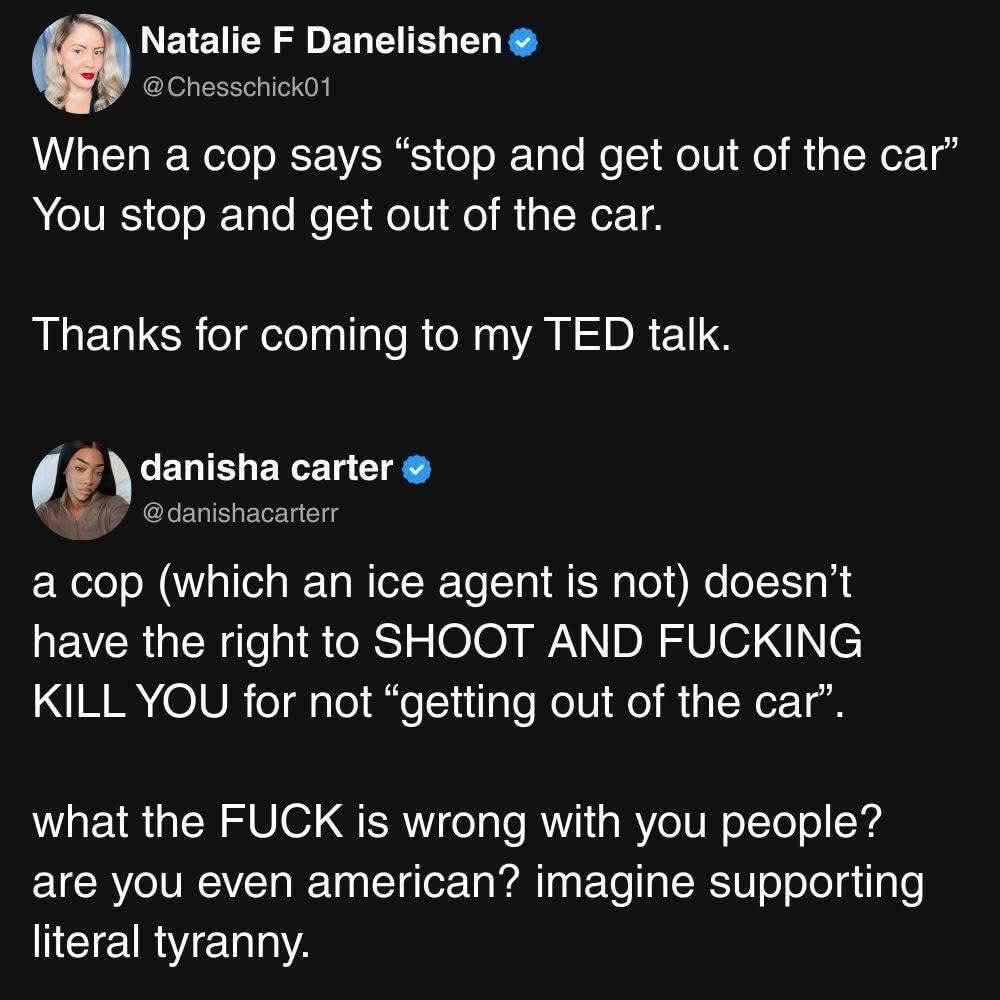
Food for thought… Cases can be checked online
From an actual lawyer… "There seems to be a lot of Keyboard attorneys online today. So, as an actual attorney, I’d like to cite actual law. The ICE officer in MN violated both protocol and case law. 1) officers are not allowed to fire into a moving vehicle 2) lethal force is not allowed to prevent someone from fleeing 3) case law is clear, an officer cannot intentionally place himself in front of a vehicle and then allege self defense At best, this officer acted with a reckless disregard for public safety and is guilty of negligent homicide. Federal agents do not have blanket immunity from state laws or criminal prosecution. They can be prosecuted by state authorities for violating state laws if their actions were unauthorized, unlawful, or unreasonable, even if they were on duty.
The concept governing this is called Supremacy Clause immunity. Federal agents are generally immune from state prosecution only if their actions were:
Authorized under federal law; and
“Necessary and proper” to fulfill their federal duties.
If a federal agent is charged in state court, they can petition to have their case “removed” to federal court. In federal court, the judge would then determine whether the agent’s actions met the “necessary and proper” standard. If the court finds the agent was acting within the reasonable confines of their duties, the state charges will be dismissed. If not, the state prosecution can proceed in federal court, applying state substantive law. It is unlikely any judge would find his behavior necessary and reasonable. The mere fact that no other officer present unholstered their weapon and appear shocked he fired towards them reinforces that fact.
Estate of Starks v. Enyart, 5 F.3d 230 (7th Cir. 1993)
Seventh Circuit – foundational caseFacts:
Officer stepped in front of a slowly moving vehicle and then shot the driver, claiming fear for his life.
Holding (paraphrased):
“An officer may not unreasonably create a physically threatening situation and then use deadly force to escape it.”
Adams v. Speers, 473 F.3d 989 (9th Cir. 2007) Ninth Circuit
Facts:
Officer jumped in front of a vehicle during a stop and then fired.
Holding:
An officer cannot provoke a confrontation and then rely on the danger they created to justify deadly force.
Key language:
The court emphasized that reasonableness includes the officer’s own tactical decisions leading up to the shooting.
Thompson v. Hubbard, 257 F.3d 896 (8th Cir. 2001)
Eighth Circuit
Key point:
The court rejected summary judgment for officers where evidence showed the officer moved into the vehicle’s path, creating the perceived threat.
Abraham v. Raso, 183 F.3d 279 (3d Cir. 1999)
Third Circuit
Facts:
Off-duty officer shot a fleeing driver.
Holding:
The court stressed that pre-seizure conduct matters and that officers cannot rely solely on the “split second” framing if their own actions escalated the situation.
Kirby v. Duva, 530 F.3d 475 (6th Cir. 2008)
Holding:
Deadly force may be unconstitutional where:
The officer fired into a moving vehicle
The officer could have stepped aside
The threat was self-created
The Sixth Circuit explicitly rejected the idea that a moving car automatically justifies gunfire.
Adams v. Speers, 473 F.3d 989 (9th Cir. 2007)
Holding:
An officer may not intentionally place himself in danger and then use deadly force to neutralize the danger he created — including firing into a vehicle.
The Ninth Circuit emphasized tactical disengagement as the constitutional expectation.
Training & Policy Alignment (Courts Care About This)
Many courts note that modern police training instructs:
Do not fire into moving vehicles
Do not use deadly force to stop a fleeing car
Disengage and contain instead
Courts treat violations of training as evidence of unreasonableness, even if not dispositive.