The government has announced it is replacing it with a double lock - but the earnings link will still remain as an option for the government to uprate the pension if earnings growth is much stronger than inflation and/ or the 2.5% figure.
1 Like
Although that effect has been seen globally. These are the figures for the US. You can see a sharp drop at the beginning of the pandemic (already disabled people dying) followed by a big increase:
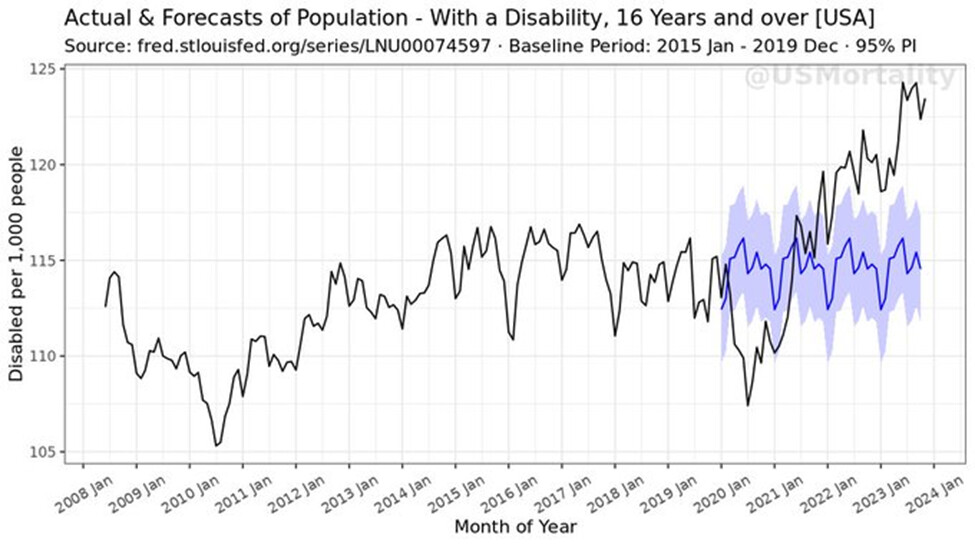
What has also been seen in the US is a growth of disabled people in the workforce with a disability, which is not necessarily a bad thing. The growth of remote working means that people who had previously been unable to work can now do so.
I’m interested to see what comes from the Milburn report on NEETs. That doesn’t cover the whole workforce, but it will touch on elements that are common across the board in terms of the actual support required.
3 Likes
for anyone that is interested in understanding @LondonRich when he talks about self reporting. Thisis the PIP2 form.
Disability for children is DLA and is a different system, so please note this is for working age people, not children.
1 Like
You’d be amazed at the amount of parents think that dla is actually theirs to pay for nights out or mortgages etc…
Its not theirs, its for the childs needs and to help towards anything they need for whatever condition, it stops when rising stats kicks in( turning 16 to then transition over to pip)
3 Likes
I agree. We definitely have a two tier employment system. Perceived “brain” jobs like finance etc get paid way more than perceived "manual’ jobs. Nurses and teachers pay is a scandal.
I also think we need to tackle the public sector. I can bang on about productivity there but thats for another day. Public sector pensions need to go. I would increase salaries by 30% and let people contribute themselves. The liability would leave the government and we would see more productivity as people could leave the public sector not be tied by the pension.
1 Like
This is another part of the welfare system that isn’t really ever discussed. Hardship for being Sanctioned.
They already contribute themselves. A 30% salary increase would actually cost the country more (although might be justified as public sector workers tend to be lower paid).
I think the new public sector pensions are now based on career average earnings rather than final salary, which had typically been the sticking point.
2 Likes
@gasband the state pension in the UK is pay as you go. It’s the same as the state pension in France known as répartition. When it was created there was economic and population growth increase which if it had continued would have paid for itself.
It will be able to pay for itself again when the boomer generation die off. The problem since a few decades is economic and population growth haven’t been sufficient to sustain it. The longer nothing is done about it the nearer we come to it ‘breaking even’ once again and then profitable to the state once again.
The UK system has moved away from complete reliance on pay as you go yet still struggles at this moment in time.
France is getting round to proposing that pensions are taxed a bit like salaries.
It’s not a bad or poor system it just relies on things that cannot be guaranteed like any other system. Capitalisation carries it’s risks, during a financial crisis you can loose over 30% of your pension over night and it has been known for company pensions to be stolen.
Once again the pay as you go system is very reliant on wages. Standard of living for many is falling so there’s a problem with wage structure where wages of many groups haven’t been keeping up with inflation.
It’s very notable that in France at the moment those demonstrating the most are young students and old age pensioners. I think we’ll see more of this across Europe. You can read here how few are happy with their lot they just can’t agree on the ‘best’ course of action.
3 Likes
like this cnut.
1 Like
That’s the famous one and of course the one I had on my mind when posting however there’s others. It was quite common for pension funds to ‘disappear’. I think there’s still a lot of fraud with private pension funds and it’s invariably the rich stealing from those poorer than themselves. This sort of shithousery is a symptom of capitalism it’s chronic now!
2 Likes
Bernie Madoff. Ponzi schemer springs to mind.
Saw something about SAD on TV this morning, apparently you can claim PIP for having it.
Another one of those difficult to disprove conditions.
Wont be long before benefits are available for people suffering from FOMO
1 Like
Wow, that is really, really low.  I knew that income tax of the richest wasn’t very high, but that low? Thanks for the information.
2 Likes
I think you are misunderstanding the distribution of payers as the marginal rate of income tax is paid by the highest earners. In England, the nominal highest marginal rate is 45% (48% in Scotland), though some situations can see it effectively reach 60%. However, most of that 1% get a significant amount of revenue from sources not directly taxed as income - which is true in most of the OECD
3 Likes
What’s that? I’d hate to lose out on money I might be entitled to.
7 Likes
Your point is what? Despite propping up the economy they are hiding wealth ?
My point is very simply that the top 1% are paying more than one form of tax, only one of which is taxed at the nominal 45% rate. Regardless of where one then wishes to go ideologically, that 48% number is not describing the whole situation. I have seen estimates that the effective tax rate for the 1% averages out to about 35%.
That number doesn’t really surprise me, the UK income tax code is generally considered one of the more complex ones. That in turn means the gains from employing expert advisory services scales significantly, with the result being that within that class of taxpayers in the highest bracket there is probably something a regressive pyramid with the people earning just enough taxable income to be in that bracket likely paying the highest effective rate.
I don’t know the UK data these days, but I don’t think the UK has made massive structural changes to the tax code in the last 30 years. Tapering that regressive pyramid was one of the design goals of the changes made to the Canadian income tax system in the 90s. As always, it only really worked around the edges, in the game of whack-a-mole played by tax authorities, the wealthy are always going to be a step ahead.
However, I do think that a British government is going to need to look at questions like this - the UK’s tax to GDP is about OECD average, but social security contributions are fairly low. The income tax system is one of the more progressive ones in the OECD, but the effective tax rate undoes that. The effect is that the UK is a pretty good place to have £100M, but not that ideal of a place to be if you earn £150K or so.
2 Likes
Ah, I thought that @LondonRich 's 27% was the nominal tax. Thanks for that info.
It’s fine. I know my free market views are in the minority here. But I want the best for our country. I want us to lead the world. Not waste money but look after people who need it.
I do not want young men in boats with no real asylum claim coming here to get benefits. I want to help genuine asylum cases. But when you come here. Respect women. Follow our culture.
Call me racism but integrate. Be British if you want to be here. Do not belittle women. Do not rob. We have made ourselves an easy target.
It’s funny how so many asylum cases are young men.
2 Likes
And yes. You can all call me Farage.