If there is a god, please allow us to wake up from this idiotic nightmare.
4 Likes
He has been told 2000 km, but his brain is so mush that he cannot remember such details.
The US is such a tragedy. But MAGA cheers and are oblivious to the disgrace and incredible loss of respect and soft power during Trump. They some how think they are “respected again” 
5 Likes
I would not rule out the possibility that Hegseth is utterly incapable of thinking in kilometres, and may not know that km = kilometers.
8 Likes
Just another day in paradise eh.. 
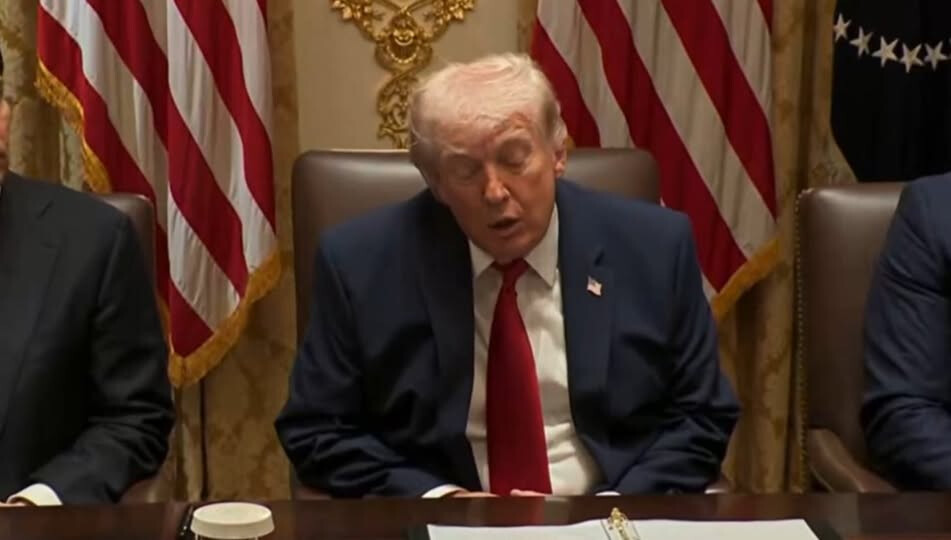
Here’s all the INSANE things that Trump said at his cabinet meeting today:
On cognitive tests: “I aced it. I got them all right… President Obama, he wasn’t a smart man. I know all about him. He wasn’t a smart man. Highly overrated.”
On his post-presidency plans:
“After the presidency, I think I may go to Venezuela and run for president against Delcy. It’s an option!”
On the missile allegedly shot at the US base at Diego Garcia:
“They shot the now-famous Ireland [sic]— the island that the UK was very afraid to give us.”
On his “big present” from Iran: “They said to show you the fact that we’re real and solid and we’re there, we’re gonna let you have eight boats of oil. Eight big boats of oil. I think they were Pakistani flagged.” (this 100% did not happen)
When Sec. Burgum told him about oil being brought to America:
“Forget that. When are they gonna do the statue of me?”
On energy prices:
“It’s not over, so maybe it’ll go up a little bit more. It’s all gonna come back down to where it was and probably lower. And my predictions have been right. Trump was right about everything. They have a new hat.”
On Iran:
“I’m the opposite of desperate. I don’t care. In fact, we have other targets we want to hit!”
On using a mail-in ballot: “I used a mail-in ballot. You know why? Because I’m President of the United States and because of the fact that I’m President of the United States, I did a mail-in ballot.”
On the National Guard in DC:
“I never wanna take [the National Guard] out of D.C. I mean, maybe somebody later on will do it, but I never wanna…We see these beautiful, strong people, and they’re so nice. They help, they open the doors for people, they carry bags, they pick up paper on the ground.”
On the Strait of Hormuz: “The amazing thing is we don’t need the Hormuz Strait. We don’t need it. We don’t need it at all. We have so much oil. Our country is not affected by this.”
On pens: “See, this pen right here. This pen is an interesting example. It’s the same thing. So this pen is very inexpensive. But it writes well. I like it. But I can’t have the pen the way it was. You know what it is. I don’t want to give too much publicity but they do treat me well. Sharpie.”
25th. Amendment. NOW.
5 Likes
And that’s why I flatly refuse to listen to him speak anymore. You’d get more sense out of a tramp in Leicester Square.
9 Likes
Was he ever worth listening to? I can remember my alcoholic uncle ended up like that. We generally ignored him and wouldn’t even let him have the remote control for the television.
7 Likes
The ravings of a demented lunatic,what kind of political system would allow his likes the time of day,let alone the power he thinks he has!
3 Likes

Good point,didn’t give Fartage a thought in my rant!
2 Likes
I could have put a LePen or some such but he came to my mind instantly…
There were a couple of posts earlier about flattening discourse and nihilism and I was going to comment then. The flattening as it is seems more a construct of the arc of time we are in. By arc I would say post 1950 to now. The politicians and the people that vote for them are a derived from everything that has occurred from that point. To expect a unicorn that is magically going to change course in an election cycle (or 3) is about as likely as said unicorn. Course correction will probably happen (or not?) but it will take time. The passing of the orange swan will not lead to an immediate (or even a foreseeably near) re-set.
edit/p.s. just to clarify, not everyone (politician or voter) is the same and there are definitely grades but the current trend is for these sorts of characters and their backers seem to hold the reins regarding the populous.
2 Likes
1 Like
It’s not Trump, it’s America
NYT Opinion piece by Lydia Polgreen
“Is Trump a freak of history or its fulfillment, an aberration or a culmination? The answer, surely, is both. But in the course of his presidency, Trump has revealed a much older malady: America’s unshakable faith in its ability to shape the world to its liking, indifferent to what others might want and supremely confident that its plan is the right one. Beyond Trump, it’s this disfiguring mentality we Americans must face.” - Lydia Polgreen
"Like a lot of other Americans, I’ve oscillated in these dark times between two emotional poles. At points, I tell myself that Donald Trump is a uniquely malevolent figure who has seized levers of power that no previous president had ever dared to grasp. The story doesn’t stop state violence in the streets or illegal military operations abroad. Yet it has its comforts. Once Trump passes from the scene — as the laws of nature, if not politics, require — some kind of restoration of the American democratic and constitutional project can take place.
On darker days, I find myself turning to a more thoroughgoing narrative: that Trump is the fulfillment of what America has always been — a self-satisfied nation, granted license by its myths about providence and exceptionalism to do whatever it wants. Trump didn’t come from nowhere, after all. His two victories were forged by choices made by Americans and the leaders they elected. If he had not existed, history would have invented someone like him. This explanation offers its own consolation. At least it is something a rational mind can grasp.
This oscillation can feel a bit like whiplash. Trump’s loss in 2020, interventions by the courts to block some of his most brazen moves and the prospect of a Democratic romp in the midterm elections sustain the aberration theory. But other developments — Trump’s popular-vote triumph in 2024, the near total submission of the Republican Party to his will and the Supreme Court’s grant of sweeping immunity to Trump for potentially criminal acts committed as president — suggest the opposite.
The war in Iran has shattered this binary. It is, to be sure, the product of Trump’s unique recklessness, as he plunges heedlessly into a conflict his predecessors had been wise to avoid. Yet it is also the logical terminus of decades of American history — the country’s addiction to technological wizardry to wage war at a distance, the blinkered belief that it could shape events in faraway places by force, the steady whittling away of constitutional limits on the presidency.
Is Trump a freak of history or its fulfillment, an aberration or a culmination? The answer, surely, is both. But in the course of his presidency, Trump has revealed a much older malady: America’s unshakable faith in its ability to shape the world to its liking, indifferent to what others might want and supremely confident that its plan is the right one. Beyond Trump, it’s this disfiguring mentality we Americans must face.
In December 1952, a Scottish scholar named Denis Brogan published a remarkable essay titled “The Illusion of American Omnipotence.” Writing as the United States was emerging as the world’s pre-eminent power, Brogan diagnosed a peculiar feature of the American mind. The United States, fueled by its myths and unswervingly certain of its vision for the world, could not see difficulty, much less defeat, as a reason to question its aims. Failure was never brought about through the strength or power of rivals. It came, instead, through blunder and betrayal.
“Very many Americans, it seems to me, find it inconceivable that an American policy, announced and carried out by the American government, acting with the support of the American people, does not immediately succeed,” Brogan wrote. “If it does not, this, they feel, must be because of stupidity or treason.” An admiring but canny observer of the country, Brogan captured something essential. America, in its own imagination, could never fail; it could only be failed.
In its struggle against global communism through the Cold War, the country had ample opportunity to show off the reflex. When China’s insurgent communists triumphed, Brogan wrote, it was widely understood as a result of American bungling or treachery. China, a vast and ancient civilization, was seen as something for America to win or lose. That failure helped give rise to the paranoia of McCarthyism. Korea, Vietnam and more covert disasters were further tinder to recrimination, long after the senator had gone. Failure could come only from internal betrayal, an idea that paradoxically bolstered the illusion of omnipotence.
When the Soviet Union collapsed in 1991, America had the chance to experience the full weight of its might. It had defeated the evil empire and stood alone as the most powerful nation the world had ever known, its former failings folded into a story of success. America’s swift and decisive victory in the gulf war that year was a showcase of the superpower’s military prowess. The United States would become the world’s policeman, putting its soldiers on the line to protect a rules-based order it led.
Yet it didn’t take long for the old pattern of failure followed by recrimination to re-emerge. America persuaded a rapidly growing China to further liberalize its economy, confident that it would become something more like America — an open and free society. When this gambit produced the China shock, hollowing out American manufacturing as China grew richer, more powerful and more autocratic, Americans would cry betrayal by their political leaders. China and its leaders hardly featured in the narrative.
Then came Sept. 11, 2001, shattering the fiction of American invulnerability to attack. There was plenty of blame to go around. Yet George W. Bush transformed the grievous wound into extraordinary power. He took America to war in Afghanistan and Iraq with an absurd plan to turn them into liberal democracies. His administration argued that in Iraq, a country with no role in the attack on America, the crisis was so urgent that the constitutionally mandated role of Congress in declaring war could be abandoned. After Sept. 11, constraints on presidential power themselves were identified as potential betrayers and stripped away.
It didn’t work, of course. The wars dragged on, killing thousands of American service members and hundreds of thousands of Afghans and Iraqis. Afghanistan today is ruled by the same movement that sheltered Osama bin Laden, the Taliban. Iraq is an exceedingly fragile and divided nation. The war gravely destabilized the Middle East, giving rise to fearsome new terrorist groups like the Islamic State and setting off a bloody civil war in Syria.
The election in 2008 of Barack Obama, a critic of the post-9/11 wars, seemed to be a moment of reckoning with American illusions. But Obama was soon bogged down by the conflicts and a global financial crisis to boot. Notwithstanding his feints toward American humility in the world, he embraced many of the outsize powers he inherited to make high-tech war in distant places with little oversight. America continued to act unbounded.
Striding onto the national stage in the aftermath of these disasters, Trump tapped into an old American story. America’s elites had betrayed the American people, he declared. Trump’s whole life was a dress rehearsal for this moment: constantly imposing his will, wriggling out of scrapes, never held accountable, born on third base and thinking he’d hit a triple. He was the American illusion of omnipotence incarnate.
Trump collapsed the distance between his personal will and American will, declaring as he accepted the Republican nomination in 2016 that “I alone can fix it.” Like America, Trump cannot fail; he can only be failed. Everything is always someone else’s fault. Handed the tools of the imperial presidency, he clearly regards America as identical with his person. He jettisons all pretense of constitutional order. He will know in his gut when wars are won, he’s said, and the only limits are his own sense of morality.
In the Persian Gulf, that illusion has come face to face with material reality. Trump’s hope of a rapid collapse of the Iranian regime was always fantastical. Geography is having its revenge: The oil and gas that power so much of the global economy pass through a narrow strait that Iran effectively controls. A ground invasion on its vast and forbidding terrain could far exceed the Vietnam quagmire. The Iranian regime, ruthless to its neighbors and its own people alike, appears unshaken by Israel and America’s relentless assaults. It seems dug in for a long war.
Yet Trump seems unable to conceive of a force immune to America’s omnipotent might. And he cannot imagine that a distant war could possibly harm America, blessed with bountiful land and natural resources, separated from the troubled world by two oceans. But soaring gas prices, rising interest rates and the prospect of a stock market collapse have put paid to any delusions of splendid isolation from the global economy. If this war grinds on, Americans will suffer greatly.
There has been plenty of suffering already: More than 58,000 names are etched onto the black granite of the Vietnam War memorial in Washington. As yet, there is no national memorial for the so-called forever wars, but over 7,000 Americans died serving in them. In those wars, there was at least a veneer of American idealism, as thin and self-deceiving as it may have been. Trump has dragged America into a war completely unmoored from any pretense to virtue. It is a naked exercise of power with no cloak of providence or moral superiority. In its brazenness, it is almost bracing.
Writing at the same time as Brogan, the theologian Reinhold Niebuhr published a short book called “The Irony of American History.” A favorite of Obama’s, it is a call to Christian humility in world affairs, addressed to Americans who misunderstand their virtue. “Man is an ironic creature because he forgets that he is not simply a creator but also a creature,” Niebuhr writes.
That line made me realize the folly of my own oscillation: Both views — Trump as aberration or Trump as history’s fulfillment — had America as the protagonist of its own story, with the world as a stage. I needed a wider frame, an honest engagement with history and a willingness to admit that America is, like any other nation, just one place in the world.
America does not know how to exist in a world it does not control. Since its inception, America has assured itself it was simply too big, too far away and too richly endowed to suffer any serious consequences for its actions. But there will be no escaping the cataclysm in Iran. In its wake, there is a chance to recognize our place in an interconnected world and see ourselves clearly. The way out of the cycle of failure and betrayal is to shed our illusions, once and for all." - Lydia Polgree is an Opinions columnist with the New York Times.
15 Likes
1 Like
The world changes all the time, sometimes slowly, sometimes more rapidly.
The Roman Empire collapsed. The French Revolution happened. Life went on.
In reality, we are mourning the loss of an order that lasted only 75 years or so. We just happen to be witness to one of those moments of rapid change.
6 Likes
Sure and the world has been witnessing extremely rapid change. This is in turn causing the base conservative reflex to hit in harder (you can add to that the increased number of older generations).
This however wasn’t my point. Normally conservative reactions don’t lead to a collapse in rules and rule of law but a reinforcement along with lots of stupid added laws. We’re just seeing a lot of stupid laws taking over, at the moment, that don’t have any sense within a functioning constitution.
2 Likes
It’s indeed pointless to listen to him. Either he’s completely out of his mind, or (more likely) it’s a strategy designed to confuse people’s minds. After all, his accomplices do the same thing. They want to dazzle us with the mindless shit coming out from their mouths.
The only thing to do is to focus on what this administration does or does not. All the rest is just noise.
4 Likes
2 Likes
I’m fascinated by this. I’m honestly not convinced.
1 Like
The modern American Conservative. I dont know what I believe in, but once you tell me what it should be I will do it so fucking hard (until you tell me we now believe something else)
9 Likes
Why is everything so ridiculously dim and ignorant with these people.
7 Likes