Maybe the PM needs to be a job share??
The boring, wooden bureaucrat who actually has a positive impact and the charismatic leader who nails the messaging.
Maybe the PM needs to be a job share??
The boring, wooden bureaucrat who actually has a positive impact and the charismatic leader who nails the messaging.
Exactly this. Even ignoring all the subsequent financial headwinds the government has faced since taking power, “core” change was never going to be deliverable within its first 2 years in power (unless you are talking about change in approach being more measured and less ‘for show’)
I think that has been a challenge for this government. It doesn’t really have too many figures that are that charismatic and could pick up the slack.
I am in the middle of a change programme at work.
It is so fucking hard, they fight dirty, and I am fortunate enough to blessed with a strong charismatic leader (pretty much the exact opposite of Starmer). It would not have even got off the ground without him (my boss, not Starmer  )
)
And all of this in an structure that is only 200-odd people (our metrics are probably as bad as the NHS’, relatively speaking).
Same problems…you cannot have an adult conversation with them about what needs to happen, although a lot of them actually think everything is peachy…not sure that is the case in the NHS.
I would just say, I have an overwhelmingly positive view of the NHS. I developed a DVT during covid, my son has a bung lung (I think that is the technical term). Given the pressures the NHS is under, I would hand on heart say until I am blue in the face that the service has been first class, albeit slow at times.
No pressure, Andy.

Well done brexit.
This country has been dying on it’s feet my whole adult life, and longer.
If anything Brexit was a result of that, not the cause.
That was pretty much the wartime national government with Atlee/Churchill in the respects roles.
Has it? Of course, it went down from being an empire stretching over the whole world towards being a simple nation among others in Europe, but is that actually a bad thing? Maybe you aren’t referring to that…
Otherwise, you guys are having a hard time because of social inequalities, which could be bettered at any given time. All it needs is people voting consistently in favour of better social equality. The country is still very rich, and has a lot of strengths and assets. So, I’m not as pessimistic as you about the UK’s future, but ok, I’m watching from the outside and don’t know the ins and outs.
One main problem for me seems to be the persistent propaganda dished out by the billionaire-owned media. Most other countries share this problem. With more balanced information sources, things would be hugely different.
i think ive seen two interviews with him.
he maybe dressed as a bin, but he is sharp as all getout and very astute and an aura of common sense about him.
could the guy dressed as a bin actually be the great new hope?
Yep - he is a political satirist, comedy writer, and knows his stuff.
I’m just talking about the PR of it.
The challenge for the UK is that the economic picture over the next 10-20 years and beyond isn’t great, with organisations such as OBR forecasting debt growing from 100% now to 150% of GDP or more if steps aren’t taken now to head that off (it was around 30% in 2010).
It’s suggested in the article linked below that the government may need to look at cuts worth £100bn sooner to prevent having to make deeper cuts later.
Obviously, faster growth would help ease this but with an ageing population, the global trade disruptions we are facing that has led to higher inflation and the dash for borrowing across both governments and companies pushing up borrowing costs, it’s an uphill struggle to see where (and when) it will come from.
Yeah, but why are these debts so high now compared to some decades ago? No doubt because the taxing structure syphons money away from the state, in favour of the highest earners and the richest people in the country ?
That is something which will have to change, as the state will then be able to resorb its debt, invest again and employ more people. But it’s only the voters who can make that happen. They need to look past the ‘evil communist’ label when someone dares making such a proposal.
Honest error. Only if you want to believe that.odious woman.
A huge part is the slow motion train wreck that is the baby boom, and the resultant aging population. State pension spending punched through 4% of GDP in 2010, having been closer to 3% for decades. It is now over 5% and with the triple lock will be 9% in about 30 years, climbing steadily - at a rate faster than projected economic growth. The story for health care spending is similar. In 2010-2011, the UK was spending about 2.5% of GDP on debt service. That peaked at 4.4% in 2022-23, but an increase in gilt rates could readily push that upward. If it goes above 5%, there will be very real pain.
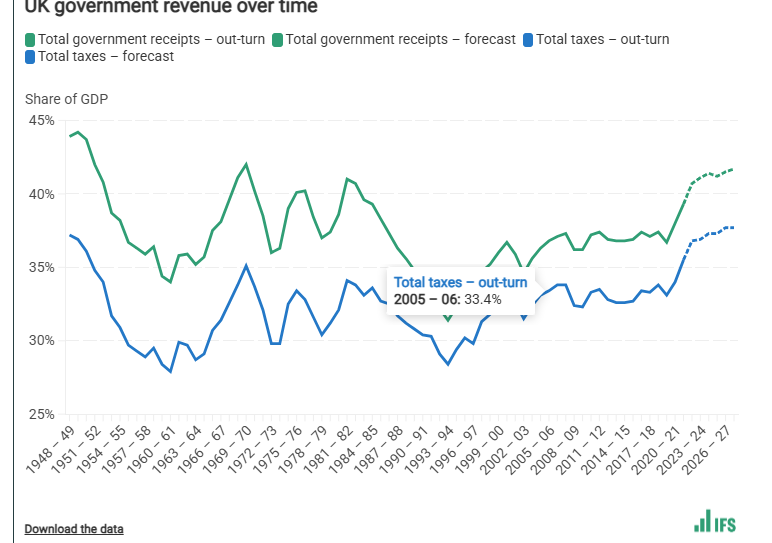
Comparatively speaking, the revenue side is not the problem. It has grown, and the tax take as a percentage of GDP is approaching the higher levels of the late 60s and through the 1870s.
The fundamental problem is that the financial model for state program spending has been premised on continuous economic and population growth. The pay-as-you-go model is incredibly vulnerable to either of those assumptions proving to be false, and the UK simply did not build up meaningful reserves for the aging population. That aging population then voted heavily to pull the handbrake and hope for the best on economic growth a decade ago.
The country is still very rich. But there’s no money.
How sure are we about this? In my mind the only way the UK raises revenue now is through taxation. They have no other revenue streams left. With substantial money effectively leaving the UK and that likely to grow, you run out of room pretty quick.
I can’t argue with you here at all. The task is beyond any single government and given our propensity to vote in people that are against or not motivated to fix it, the NHS is likely to be doomed.
My only response is when you’re in a hole stop digging.
Well, when you are in tough budgetary times, revenue is never not a problem. But revenue has been increasing in both absolute and relative (% of GDP) terms, after being stable for over a decade at levels well above the low levels of 1996-2006.
Writ large, the opportunity to start fixing this at comparatively low cost was about 30 years ago.
Ta. Very useful.
Damn. Look at the revenue and spikes in the 50’s through to the 80’s. That’s wild. The drop from 82 to 93 is very telling I think.