I remember that while at uni many many moons ago. A mate or two suggested it. I was apprehensive given the title, and having zero clue what it was about. I was wrong. Very wrong.
Kind of reminds me of Dusk till Dawn which had a completely unexpected storyline.
In case you haven’t seen “The Toys That Made Us” on Netflix…they explain the origin pretty well there. The cartoon series was purely a vehicle to sell toys.
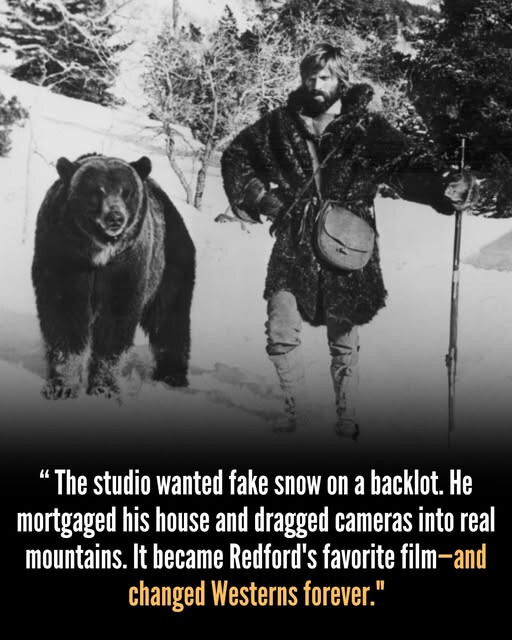
The studio wanted fake snow on a backlot. He mortgaged his house and dragged cameras into real mountains. It became Redford’s favourite film—and changed Westerns forever.
In 1972, Jeremiah Johnson brought the Rocky Mountains to life with nothing more than a rifle, a mule, and Robert Redford’s piercing gaze cutting through the wilderness.
This wasn’t just another Western. It was a meditation on solitude, survival, and the silence that only snow-covered peaks can offer. And making it nearly destroyed everyone involved.
Warner Bros. had a simple plan: shoot the entire film on a studio backlot in Los Angeles. Fake snow. Controlled conditions. Predictable costs.
Robert Redford and director Sydney Pollack had a different vision. They insisted the film had to be shot on location—in real mountains, real snow, real wilderness. The studio reluctantly agreed, but only if they could match the backlot budget.
Pollack accepted the challenge.
Art director Ted Haworth drove over 26,000 miles scouting locations across Utah’s most remote terrain. The crew ultimately filmed at nearly 100 different sites—from Mount Timpanogos to Zion National Park to the Wasatch Range.
Principal photography began in January 1971, and the conditions were punishing.
Filming in deep mountain snow presented problems most directors never face. Actors had to be transported by snowmobile into remote positions, then called out by two-way radio at the exact moment of filming—because even a single set of footprints would ruin the pristine snow shots.
The budget was so constrained that Sydney Pollack mortgaged his own home to keep production going.
They weren’t making a movie. They were surviving one.
One scene captures the film’s raw authenticity perfectly. Redford’s character—a greenhorn trying to learn mountain life—meets Bear Claw Chris Lapp, the grizzled trapper played by Will Geer (who audiences would later know as Grandpa Walton on television).
After asking the newcomer if he could skin a grizzly, Bear Claw suddenly charges through his cabin with a real bear in pursuit, leaps out the back window, and hollers: “Skin that one, pilgrim, and I’ll get you another!”
A real bear. Not a trainer in a costume. Not CGI that didn’t exist yet. An actual grizzly bear.
According to Pollack, capturing the scene safely required extraordinary patience and countless takes. But they got it.
Redford insisted on doing his own stunts throughout production. As he explained: “I like the tough stuff. Half the fun of making movies is doing the action scenes. I never do the stunts where a pro can pull it off safer and better. But I do like to do the action where the camera is too close to tell a lie.”
He meant it. Watch the film knowing Redford is actually riding those horses across those cliffs, actually trudging through that snow, actually living in that wilderness—and the authenticity becomes undeniable.
When filming wrapped, Warner Bros. barely promoted it. They’d gotten their movie within budget, but they didn’t believe in it.
So Redford broke his own rule against publicity tours and traveled extensively to generate interest in what he considered one of his most important projects.
The gamble succeeded spectacularly.
The film earned rave reviews and made over $21 million domestically against a budget of just $3.1 million—becoming one of the most profitable films of 1972. It became the first Western ever accepted into competition at the Cannes Film Festival, forcing the film establishment to recognize that Westerns could be art, not just entertainment.
More than 50 years later, Jeremiah Johnson still resonates in ways few films do.
It’s about retreating from a world too loud, too fast, too broken—and trying to live by your own code. It reminds us that nature isn’t just scenery or a backdrop. Nature is a character. Sometimes nature is the antagonist. Sometimes it’s the only honest thing left.
The film asked a question that feels more relevant now than ever: What would you do if you walked away from everything and tried to live on your own terms?
Redford himself has called it one of his favorite films—perhaps because making it required the same resilience, determination, and refusal to compromise that defines Jeremiah Johnson himself.
If you haven’t watched it lately, it’s time to return to the mountains.
Not the fake ones built on soundstages. The real ones—where a director mortgaged his house, where a bear actually chased actors through a cabin, where Robert Redford learned that sometimes the hardest scenes to film are the ones that matter most.
Where silence speaks louder than dialogue ever could.
And where a film about escaping civilization became a masterpiece by refusing to fake anything.
Went to the cinema last night to see ‘Is This Thing On?’
It’s a vaguely unsatisfactory movie about a couple who try to cope with a crisis in their marriage by taking up new hobbies, volleyball coaching for her, and standup comedy for him.
The main interesting thing in the film is a couple of subtle inferences that he’s a Liverpool fan. Firstly, he’s seen humming Allez Allez and secondly, he wears an LFC top. This despite the film being set in New York.
The reason is, that it’s (loosely, I think) based on the life of John Bishop.
We saw it at a major complex in the city, where, worryingly, the usher told us that numbers are way down and staff are seriously concerned about their jobs.
A few years ago, there was a very unpleasant poster here who said I was just wasting everyone’s time with my comments and that I was a troll, sigh. So I changed my avatar… because every forum should have at least one official troll as a member, I thought
The Substance was surprisingly good. I know there was a lot of focus on the nudity and “bravery” of the performances that made it a curiosity for people, but I thought it was genuinely intriguing