But, but, but … why does a mirror flip left to right but not up and down?!? 
(An interesting follow-up to get your head around).
""
The mirror didn’t flip it, you did!
But, but, but … why does a mirror flip left to right but not up and down?!?
(An interesting follow-up to get your head around).
The mirror didn’t flip it, you did!
Because it literally reflects what is in front of it.
If I stand in front of you, I see your right arm on my left hand side etc, as you also see mine. As that diagram above shows, the flat surface will bounce the light straight back, unlike the spoon.
It would be impossible for a mirror to show my right and left sides as I know them, because it would surely then have to show me my body from the back to do that.
So, is there no… dark side of the spoon?
No, only the back side… which doesn’t exist, … but it does… not, … kinda
Because it’s not curved.
Schrodinger’s spoon?
Damn, you people are all rich, I look at our spoon and all I see is a scratchy blur reflection.
Or retired and have too much time to polish said spoons. 
Maybe Scrotum, his wrinkled retainer, is no longer up to the job of polishing his spoon?
Not sure which camp I would have been in if answering this 
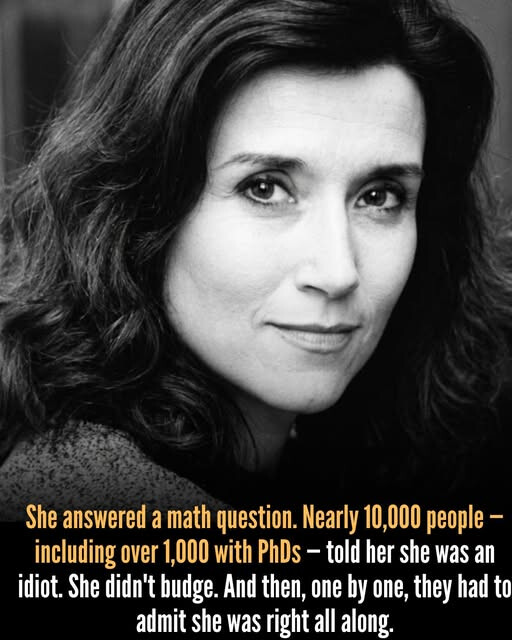
In September 1990, a column ran in Parade Magazine that looked, on the surface, completely ordinary.
It was called “Ask Marilyn.” The columnist was Marilyn vos Savant — a woman who had been listed in the Guinness Book of World Records for the highest recorded IQ score ever measured. Every week, she answered puzzles and questions from readers: logic problems, riddles, philosophical knots. She answered them with clarity and precision, without academic jargon, in a voice that anyone could follow.
Then came the letter that would trigger one of the strangest intellectual controversies in modern history.
A reader named Craig Whitaker wrote in to describe a puzzle inspired by the old television game show “Let’s Make a Deal”:
Imagine you’re a contestant. There are three doors in front of you. Behind one is a brand-new car. Behind the other two are goats. You pick Door #1. The host — who knows exactly what’s behind every door — opens Door #3 to reveal a goat. Then he asks you: “Do you want to switch to Door #2?”
Should you?
Marilyn’s answer was direct: Yes. Switch. Always switch.
Your original door had a one-in-three chance of hiding the car. That doesn’t change when the host opens another door. The remaining unopened door now carries a two-in-three chance. Switching doubles your odds.
She was right.
What happened next was unlike anything that column — or arguably that magazine — had ever seen.
The letters came in waves. First dozens, then hundreds, then thousands. By the time it was over, Marilyn vos Savant had received an estimated 10,000 pieces of mail about a single column. Nearly 1,000 of those letters came from people with PhDs — many of them writing on official university letterheads, from mathematics and statistics departments, from people who taught probability for a living.
They were unanimous: she was wrong.
“You blew it, and you blew it big,” wrote one PhD from the University of Florida. “There is enough mathematical illiteracy in this country, and we don’t need the world’s highest IQ propagating more.”
“You are utterly incorrect,” wrote a mathematics professor from Georgetown University. “How many irate mathematicians are needed to get you to change your mind?”
“You are the goat!” wrote another.
And then, because this was a woman daring to answer a math question publicly, the letters went somewhere else too.
“Maybe women look at math problems differently than men,” one professor suggested in print.
Think about that sentence for a moment. A woman with the highest recorded IQ in the world, answering a probability puzzle correctly, was being told by credentialed academics that perhaps her gender was the problem.
She received 10,000 letters. According to her own account, nine out of ten of them disagreed with her completely.
Marilyn vos Savant did not apologize. She did not backtrack. She did not soften her language or hedge her answer to make the critics more comfortable.
She explained it again. More clearly. From a different angle.
She asked readers to imagine not three doors, but 100. You pick one. The host opens 98 doors, all of them goats. Now just two doors remain: yours and one other. Would you switch?
Of course you would. Your original door had a one-in-100 chance. The one remaining door holds a 99-in-100 chance. The host’s knowledge changed what the other door represents — it has absorbed all the probability of those 98 eliminated doors. Switching is not a coin flip. It is the rational choice.
The principle is identical with three doors. The numbers are just smaller.
Still, the experts held firm.
So she did something else. She asked teachers to test it.
Classrooms across the country ran the experiment. Students split into two groups — half always switching, half always staying with their original choice. They played hundreds of rounds each. They recorded the results.
The switchers won roughly twice as often. Every time. In every classroom. Across hundreds of trials.
Computer simulations confirmed the same result across tens of thousands of runs. The math, as it turned out, was not a matter of opinion.
Then something remarkable happened. Slowly, quietly, individually — the letters began to change. Professors who had written with absolute certainty began writing again. Not with condemnation this time. With something much harder to put into words: the admission that they had been wrong.
Even Paul Erdős — one of the most prolific and celebrated mathematicians in history — remained unconvinced until he was shown a computer simulation demonstrating the result for himself. Wikipedia He then admitted he had been mistaken.
One by one, they came around.
But Marilyn’s story carries something larger than a probability puzzle, as counterintuitive and mind-bending as that puzzle is.
Why couldn’t brilliant people see this? Why did experts — people who taught mathematics, who had spent careers studying logic and statistics — get it so spectacularly wrong and then double down so aggressively?
Because our brains are not built for probability. When we see two closed doors, we feel, intuitively and completely, that the odds must be fifty-fifty. The feeling is overwhelming. It feels like common sense. It feels like logic. It is neither. It is a cognitive trap, and it snaps shut on PhDs exactly as reliably as it snaps shut on everyone else.
We trust our instincts over evidence. We trust our initial certainty over new information. We trust our expertise over someone else’s explanation, especially when that someone else is a woman answering a math question in a popular magazine.
That combination — cognitive bias plus gender bias — is what turned a probability puzzle into a national scandal.
Marilyn vos Savant had no army of credentials behind her. She had no institution issuing statements on her behalf. She had no colleagues rallying to her defense in academic journals. She had her reasoning and her refusal to abandon it, even as thousands of people with letters after their names told her, with absolute confidence, that she was foolish.
She was not foolish. She was right.
Today, the Monty Hall Problem is taught in statistics and psychology courses around the world — not just as a lesson in probability, but as a lesson in how certainty can blind us, how expertise can calcify into arrogance, and how being right is sometimes the most isolated place a person can stand.
There is a version of this story that ends with a triumphant vindication scene — a moment where someone hands her a trophy and the crowd cheers. That’s not what happened. What happened was quieter and stranger: thousands of smart people slowly, privately, in their own time, admitted to themselves that they had been wrong. Not all of them sent a second letter. Not all of them corrected the record publicly. The retraction, when it came, was often whispered.
But the truth — the actual mathematical truth — was never in any doubt after the classrooms ran their experiments and the computers ran their simulations.
Marilyn had known it from the beginning.
The real lesson here is not about probability. It’s about the difference between confidence and competence, between the certainty we feel and the certainty we’ve earned. It’s about what happens when those two things diverge, and someone with less social authority and fewer credentials happens to be the one holding the truth.
Sometimes the hardest thing in the world is not finding the right answer.
It’s standing by it alone, in public, under fire, for months — until the world catches up.
Marilyn vos Savant did that.
And she never asked for permission to be right.
Bloody Hell, AI can be verbose, can’t it?
Interestingly, my brother-in-law lectures at Oxford around the public perception of risk. He uses the Monty Hall problem as a teaching aid and he says a surprising number of his students can’t get their head around it.
If a goal is scored at 30 mins, but the assist is 29 minutes and 59 seconds, is the scoring stats (G 30, A 29).
No
Once it goes past 30 seconds as an assist, it counts in the next minute. That law on assists only applies when the goal is scored in the next minute, as you suggested. There was some confusion, exploited by a betting syndicate and this forced FIFA into a decision in 2021. Its called the Stapleton ruling, as he was the player that assisted in a Scottish cup tie .
I might have made all of that up.
No idea. I ended up with a tit.
My attempt ended up correct - not sure how he got it
Probably playing the numbers game. I’m not sure what happens if your mother’s name is Beatrix.
Elizabeth
Hungary
Yam (not a fruit?)
Merlin
And he said eagle. 
You lucky bugger!